





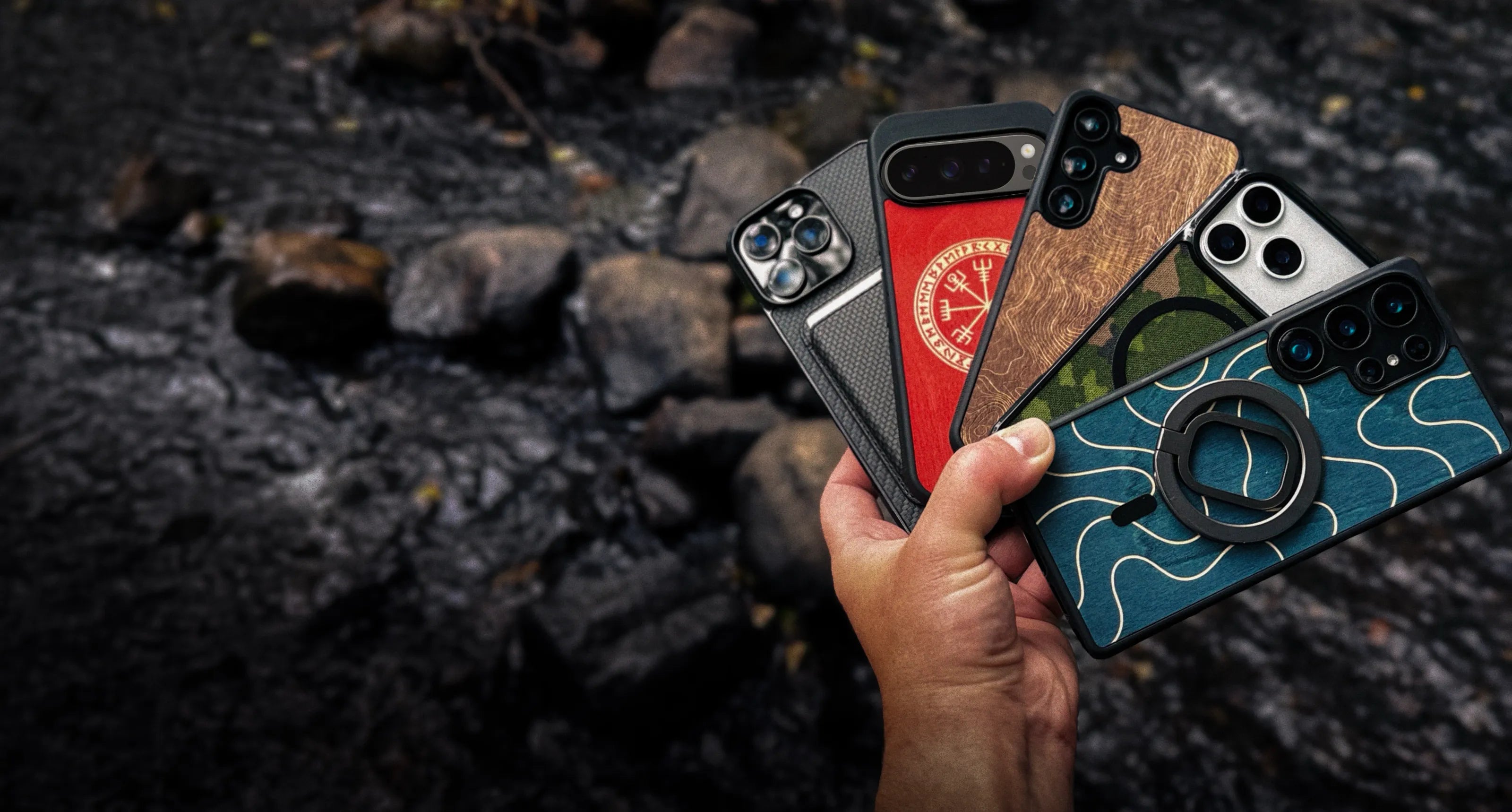
Genuine wooden phone cases made from birch – color, treatment, and why it feels different
The back of every Lastu wooden phone case is genuine Nordic birch. No print, no wood-patterned plastic, no film. Here’s everything worth knowing about that wood: where the shades come from, how they’re treated, why the surface is intentionally matte, and what tar does.
Updated 13 Aug 2026 · The color range evolves — check the collection page for the latest shade list.
Are Lastu wooden phone cases made of real wood?
Yes. The back plate of every Lastu wooden phone case is genuine Nordic birch — one layer of real wood, with grain that runs through the surface rather than being printed on it. Around the birch is a shock-absorbing frame that lifts the screen and camera off the table. The color is infused into the wood using a non-toxic staining method that meets the standard for children’s wooden toys (EN 71 and ASTM), and the surface is intentionally finished matte so the case stays secure in your hand. Every case is sanded, stained, and finished by hand in the Lastu workshop.

 Why birch
The Nordic wood
Birch is the most common deciduous tree in our Nordic homeland, and it has been part of everyday life here longer than anything in your pocket. At Midsummer, people make a sauna whisk from young, flexible birch branches, picked while the leaves are still soft and smell sweet. In the steam, that scent is released — and with your eyes closed, you know it’s a Nordic summer.
But the sauna whisk is just one use. Birch has been used to make sleds and ski bases, axe handles, birch-bark shoes and backpacks, ladles and troughs, shingle roofs, spinning-wheel parts, and the glowing heart of the sauna stove. When something had to be durable yet light, it was made from birch. When a house was built, birch bark was placed between the logs as moisture protection — it doesn’t rot.
For us, birch isn’t an exotic design material chosen for a brochure. It’s the tree that grows at the edge of the yard, its leaves announcing the change of season before the calendar does. When we turn it into phone cases, we continue a chain that has been running for hundreds of years. The same tree, a new tool to protect.
Why birch is built for everyday phone life
Northern birch grows slowly. Short summers and long freezes make the annual rings dense, and dense wood is hard. At the same time, it’s lightweight — birch won’t bulk up your phone in your pocket, even though the feel in your hand is in a completely different league from plastic.
- Dense and strong: slow-grown Nordic birch handles knocks and scratches better than fast-grown wood.
- Warm in the hand: wood doesn’t absorb cold the same way metal does. In freezing weather, you feel the difference from the very first grip.
- Unique grain pattern: every sheet is cut from a different part of a different tree. No two phone cases are the same, and we’re not trying to make them so.
- Lightweight: birch is naturally lighter than most solid plastic cases.
- Doesn’t yellow: transparent silicone yellows during the first summer. Wood ages, but it ages beautifully.

We color, sand, and finish every piece of wood ourselves
We don’t buy pre-colored sheets from anywhere. The wood comes to us raw and goes through the entire journey in our own workshop in Northern Finland: shaping it for the phone model, sanding, coloring, finishing, and sanding again. By hand, one piece at a time. It’s a slower way, but it’s the only way to ensure the shade is right, the structure is right, and the quality is exactly what we promise.
Wood doesn’t absorb color evenly like plastic. One sheet drinks in more, another less, and a knot always behaves in its own way. When a person colors it by hand, they see that and react to it. A machine doesn’t.
Non-toxic – for real, not just marketing
We use wood coloring that complies with EN 71- and ASTM standards. It’s the same safety level required for children’s wooden toys — products a child might put in their mouth. The surface contains no toxins, heavy metals, or harmful solvents, only natural substances.
In practice, that means you can hold the phone case in your hand all day without worry. A phone is picked up well over a hundred times a day on average; we didn’t want to make a surface you’d have to think about.
Multi-layer finish – the result of hundreds of tests
The current finish is the result of hundreds of experiments. It’s built to handle what a phone actually goes through: sand, sweat, moisture, freezing temperatures, coffee stains, the bottom of your pocket, and a bunch of keys.
- Repels water and dirt: rain showers, morning dew, and splashes roll off the surface. Swimming is another matter — the phone case is water-repellent, not waterproof.
- Does not fade: the color is absorbed into the wood, not sprayed on top. The sun will not eat it away, and the shade will not change after a year of use.
- Withstands wear: the surface protects the color even where your fingers rub the Case in the same spot every day.
- The feel of wood remains: the finish does not create a thick plastic film over the wood. The phone case still feels like wood.
Matte does not mean unfinished. It is a choice.
Many competitors finish wood with a glossy lacquer because it looks impressive in product photos. We do not. Glossy lacquer is slippery: it slips from your hand, slides off a car dashboard, and escapes the edge of a table exactly when it should not. It also hides the wood underneath — your finger feels the lacquer, not the birch.
The surface of your Lastu is kept matte and the edge profile textured so the phone case stays put. The grip is secure even with gloves on and with wet hands. Yet the same matte surface repels water and withstands wear — gloss is not needed for protection, it is purely a visual choice. Read more about the protectiveness of our Case →
TERWA and KELO – treated with genuine Nordic tar
In the backwoods of Kainuu, tar pits smoked for weeks, and tar boats came down the river to Oulu. In the 1800s, Oulu was the world’s largest tar port: the same substance kept sailing ships’ ropes and decks in shape across the Atlantic, and the whole city smelled of it. Lastu was born in that city. TERWA and KELO are that tradition in modern form — just on a slightly smaller scale.
Both Case are treated with genuine Nordic tar. Tar is not a color but a treatment: it absorbs into the wood, seals it, and makes the surface naturally water-repellent. That is exactly why it has been used on boats, roofs, and fences for hundreds of years — and why tar-treated birch handles a rain shower, morning dew, and fishy hands without complaint.
That scent
The tar-treated Case has a scent. Not like a fragrance — like real tar: smoky, resinous, slightly sweet. It is at its strongest during the first few weeks, carrying you to the benches of a smoke sauna and a September shoreline rock. After that, the scent softens and becomes something only you know — you notice it when you lift the phone close to your face.
Tar does not stick or stain your hands. It also does not fade, because nothing has been sprayed onto the surface only to disappear. Tar-treated birch only deepens with use.
Current colors
All the shades below are the same Nordic birch. The difference comes from what is done to the wood — and how deep the color is allowed to go. That is why the grain shows through every shade, and no case is a copy of another.
| Shade | Color | Character |
|---|---|---|
| LUMI | Natural white | Birch’s own shade as it is, with no color at all. A February morning when snow has fallen overnight and no one has walked across it yet. |
| HIILI | Charcoal black | Black has been carried all the way into the wood. The grain lives beneath the darkness — a black case that is not the same black case everyone else has. |
| KAAMOS | Deep night blue | Dark as the sea in daylight, almost black under a lamp. The blue sky of polar night, captured. |
| HORSMA | Raspberry magenta | Fireweed in a clearing in July. Raspberry in daylight, wine in the dusk — a color that dares. |
| RUSKA | Dark red | A September fell slope. Burgundy in daylight, almost brown under a lamp. An understated way to wear red. |
| TERWA | Dark brown | Tar-treated birch. Smells like real tar, naturally repels water, and deepens with use. |
| KELO | Gray | Tar-treated and dry like weathered pine. An alternative to cold aluminum and matte black plastic. |
| KUKSA | Coffee brown | Limited batch: coffee grounds and birch together. A lively, slightly unpredictable surface — even we do not know in advance what your case will look like. |
You cannot get the same colors anywhere else
We do not order shades from a catalogue. They are developed by us, mixed by us, and applied to the wood by us — in our own workshop in Northern Finland, by the same hands that sand the Case to completion. KAAMOS, HORSMA, or RUSKA do not exist anywhere else, because they are not sold to anyone else.
That is also why the shades vary slightly from one case to another. Handcraft does not have the uniformity of an assembly line — there is a person who looks at the sheet and decides when it is ready. Two RUSKAs are siblings, not twins.
The material is Nordic, the work is Nordic, and the tradition is Nordic. Lastu has been doing this in Northern Finland since 2011 — for over 200,000 customers. The birch comes from FSC-certified Nordic forests.
A cheap "wooden case" is usually not wood
Online stores are full of phone cases that look like wood in product photos. Many of them are plastic with a printed wood pattern, or a plastic phone case with a thin wood veneer film glued on top. You can feel the difference right away: the printed surface is flat and cold, and the pattern repeats from case to case exactly the same way.
At Lastu, all materials are genuine. Wood is wood, tar is tar, and camo phone cases are made from real military fabric, not a printed pattern. It costs more and takes longer.
- Compare the grain pattern in two photos: if the pattern is identical, it’s a print.
- Check the edge: in real wood, the grain continues through the thickness of the sheet. In a film, it stops.
- Look for knots and natural variation: perfectly uniform “wood” isn’t wood.
- Check the scent: real wood smells like wood, tarred birch smells like tar. Plastic doesn’t smell like anything.

Why they’re not ready on the shelf – and why you can customize them
Lastu cases are made to order. Your phone case hasn’t been waiting for you in a warehouse: the wood is selected, shaped, stained, and finished only after you place your order, specifically for your phone model. That means waiting a few business days — and it also means no phone case ends up as waste from unsold stock.
And because the phone case is made for you anyway, you can make it whatever you want. You can’t do that with a mass-produced product.
Engraving
A name, date, coordinates, the Finnish Lion, or a ready-made design from our selection — permanently engraved into wood.
Engravings →Your own image
A photo, drawing, or logo engraved into birch. The live preview shows the final result before you order.
Your own image →Map
Your hometown, cabin shore, or that one intersection — engraved as a map on the wood surface.
Map →MagSafe in brief
MagSafe is a magnetic ring inside the phone case. It keeps a wireless charger, stand, wallet, or finger grip in place without you having to align anything by hand — the accessory snaps on by itself and stays straight every time.
In Lastu’s wooden phone cases, MagSafe is available as an add-on option. The magnets are installed behind the birch, so nothing shows on the surface: you still see the wood and its grain. Wireless charging works through the phone case at full power, and the magnets also work with Android phones that don’t have a built-in MagSafe ring.
Frequently asked questions
Is the wood phone case treatment non-toxic?
Yes. We use wood dyes that comply with EN 71 and ASTM standards — the same safety level as wooden children’s toys. The surface contains no toxins, heavy metals, or harmful solvents — only natural substances. You can hold the phone case worry-free all day.
Does a wooden phone case fade in the sun?
No. The color is absorbed into the wood, not sprayed onto the surface, so it won’t wear off or change shade. The tar-treated TERWA and KELO shades actually deepen with use. A clear silicone case usually yellows during its first summer — wood doesn’t.
Can a wooden phone case handle water?
The phone case repels water: a rain shower, morning dew, splashes, and wet hands are no problem. In tar-treated shades, the water repellency comes directly from the tar; in others, from a multi-layer finish. The phone case isn’t waterproof, though, so we wouldn’t take it swimming.
Is a wooden phone case slippery?
No. The surface is intentionally left matte and the edge profile is textured so the phone case stays put on its own. We don’t finish the wood with a glossy lacquer like many others, because a shiny surface slips from your hand and slides off the edge of a table. The grip is secure even with gloves on.
What does a tar phone case smell like, and for how long?
Like genuine Nordic tar: smoky, resinous, and slightly sweet — not like a fragrance. The scent is strongest during the first few weeks and then softens into something subtle. Tar doesn’t feel sticky or stain your hands.
Do MagSafe and wireless charging work with a wooden phone case?
Yes. MagSafe can be selected as an add-on, in which case the magnetic ring is installed behind the birch — it won’t show on the surface. Wireless charging works through the phone case at full power, and the magnets bring MagSafe accessories to Android phones too.
Why aren’t all colors always available?
Because we dye, sand, and finish everything ourselves by hand, and constantly test new shades. Some shades stay in the range, some are seasonal, and some are limited batches. The up-to-date selection is shown in the wooden phone case collection.
Which phones do wooden phone cases fit?
We make wooden phone cases for iPhone, Samsung Galaxy, Google Pixel, OnePlus, Realme, and Nothing Phone models, including older generations. Because the phone cases are made to order, new models are added to the range soon after launch.
Related topics
Materials and production

Choose the shade, we’ll handle the wood
Genuine Nordic birch, hand-dyed and finished in Northern Finland. Choose your phone model, shade, and add MagSafe or engraving if you like — and see the result in the preview before ordering.
iPhone 18 Pro, 18 Pro Max and iPhone Ultra – rumors, specs and Case
Genuine camouflage phone cases: M05, M04, MM14, Flecktarn, M90 and MultiCam