





Authentic camouflage phone cases: M05, M04, MM14, Flecktarn, M90, and MultiCam
Lastu’s camo phone cases don’t use a printed pattern. They’re cut from the same fabric used in real military gear: seven fabrics from five countries, each with its own character. Here’s the story behind the patterns — and what the fabric can handle.
Updated 13 Aug 2026 · The fabric selection changes depending on what surplus is available.
Are Lastu’s camouflage phone cases made from real military fabric?
Yes. Every camo phone case is cut from real military fabric — not a pattern printed on plastic or a patterned film. The collection includes seven fabrics from five countries: the M05 woodland pattern and M05 snow pattern, the M04 desert pattern, Ukraine’s MM14, Germany’s Flecktarn, Sweden’s M90, and the United States’ MultiCam®. Most are 500D Cordura, which repels water and dirt and withstands abrasion. Because the fabric is cut from a roll one piece at a time, the pattern lands in a different spot on every phone case — no two are the same.
500D Cordura – why this fabric
Cordura isn’t a pattern — it’s a fabric. It’s a technical material woven from high-strength nylon thread, developed to withstand what tears ordinary fabric apart: abrasion, tension, and weather. The number 500D tells the thread thickness (denier) — 500D is the sweet spot where the fabric is already highly wear-resistant, but not yet stiff or heavy. That’s why it’s also used for hiking backpacks, tactical vests, and weapon cases.
- Repels water: the fabric has a water-repellent finish (DWR) and a polyurethane coating. A raindrop stays on the surface instead of soaking in.
- Withstands abrasion: the dense Oxford weave and high-strength nylon handle pockets, keychains, and the bottom of a backpack.
- Repels dirt: the same coating that keeps water out also keeps dirt off. A damp cloth is enough.
- Won’t stretch or tear: tear strength is nylon’s superpower — a small nick won’t start spreading.
- Lightweight: durability comes from the thread, not thickness, so the phone case stays slim.
 🇫🇮 Finland
M05 and M04 – patterns calculated from Nordic forest
M05 wasn’t drawn by a graphic designer. In the early 2000s, the Finnish Forest Research Institute photographed Nordic forest types, and VTT calculated one unified four-colour pattern from the images. A dark charcoal grey was added to create a shadow effect in the pattern — that’s exactly what separates M05 from an ordinary “green and brown” print. The pattern was introduced by the Defence Forces starting in 2007, replacing the old M91.
For a long time, the pattern couldn’t be bought anywhere: the Defence Forces kept it licensed. Only then 2016 the pattern was also released for civilian use. That’s why genuine M05 still feels like a special material — it hasn’t been sitting on shop shelves its whole life.
M05 woodland pattern · 500D Cordura
The basic version, and what most people mean when they say “M05”. Four colours and a charcoal-grey shadow, with soft-edged fragmentation that breaks up the silhouette at several distances at once. Lastu’s M05 fabric is the same 500D Cordura used in field gear and bulletproof vests — not the thin blended fabric of a uniform.
M05 frost pattern
Same pattern, different palette: the bright green of the woodland pattern has been replaced with grey. It’s the colour of November — frost, bare trees, moss already turning brown. In the Defence Forces, the frost pattern is made exactly for that: autumn and early winter, when there’s no snow yet but the green is gone. In everyday use, it’s the most understated M05, and that’s exactly why many choose it.
M04 desert pattern · ripstop
The Nordic desert pattern was born before M05 out of practical necessity: Nordic troops were sent on crisis management missions to hot countries without suitable gear. M04 was introduced in 2003 in the UN operation in Eritrea, and became the Defence Forces’ hot-weather uniform pattern. On a sand-light base, it has green and brown pixel patches — the same thinking as M05, recalculated for a different climate.

Four patterns, four different ways to disappear
MM14 · Ukraine · 500D Cordura
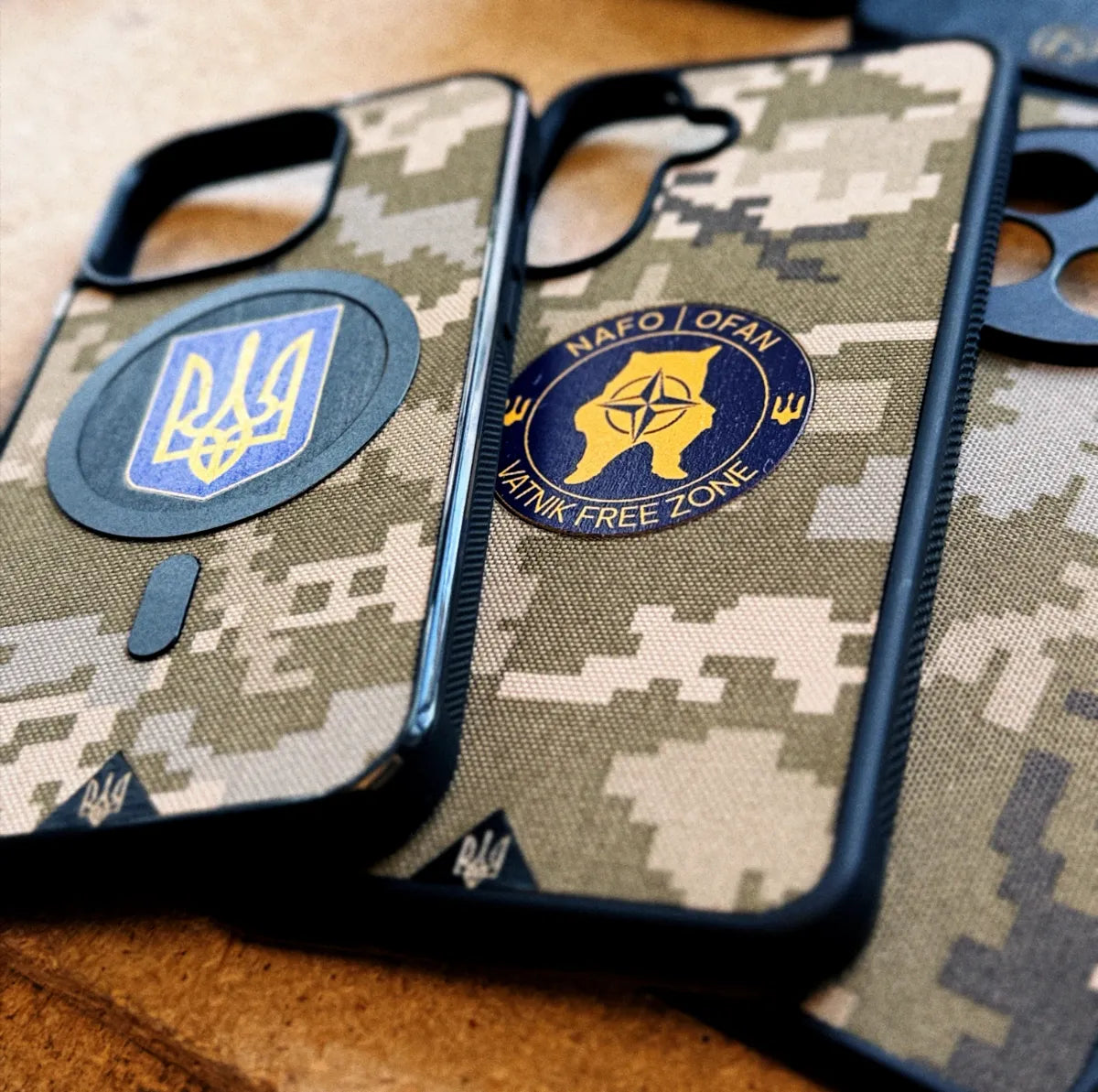
MM14 was designed in 2014, the same year it was needed. The pattern was presented to the public in Odesa in August 2014, and Ukraine’s Ministry of Defence officially approved it in July 2015. It replaced the Soviet-era Dubok pattern. MM14 is a five-tone pixel pattern — light beige, light green, marsh green, gray-green, and dark gray — inspired by NATO pixel patterns such as MARPAT and CADPAT. One pattern for three terrains: forest, steppe, and city.
MM14 is also a pattern with an end date: Ukraine has announced it will move to the MultiCam-based MM-25. That already makes this fabric a marker of its era.
Flecktarn · Germany
The name is straight German: Fleck means spot and Tarnung means camouflage. The Bundeswehr began pattern trials as early as 1976, and the five-color Flecktarn B was selected as the winner, approved in 1989, and entered wide use in 1990. The idea is different from pixel patterns: small, overlapping spots blend the colors in the eye, leaving no hard edges in the pattern. The same end result as digital pattern blocks, but 15 years earlier and a little rounder.
M90 · Sweden · 500D Cordura
The Swedes went in a different direction from everyone else. FOA, the Swedish Defence Research Agency, developed the pattern in the 1970s for vehicles and camouflage nets, and it was built from sharp-angled, shard-like shapes — not soft blotches. When the pattern was adapted for field uniforms in the late 1980s, its scale was reduced to a fraction of the original. Black, dark green, olive, and sand with high contrast: from a distance, M90 looks like shattered glass, and that’s exactly why it works in northern coniferous forests.
MultiCam® · United States · Cordura
MultiCam was designed by Crye Precision in 2002 together with the U.S. Army Soldier Systems Center. The goal was unusual: one pattern that would work in forests, deserts, and cities — instead of a separate pattern for each. The solution is seven colors in gradient layers: a base shifting from brown to sand, green gradients on top, and dark brown and cream shapes as the uppermost layer. That’s why the same fabric can look green in one area and brown in another. The pattern is used in over 40 countries, and it is the most copied pattern of the current generation.
No two are the same, because fabric cannot be cut twice from the same spot
The repeat of a camo pattern is much larger than the back of a phone. When a case is cut from the roll, it always lands on a different part of the pattern: one gets a dark patch in the middle, another a light edge, a third two spots that look like a face. We do not cherry-pick the section or align the pattern — that would create waste, and it would take away exactly what makes this so good.
A printed case is a different thing. There, the pattern is a file, and the file repeats identically as many times as the printer can manage. If two camo cases look exactly the same, they are not fabric.
For others, camo is a picture. For us, it is fabric.
Most “camo cases” on the market are silicone or plastic with the pattern printed on them or a patterned film glued on top. It looks real in the product photo and feels like plastic in your hand — because it is plastic. The pattern is also often redrawn for copyright reasons, meaning it is not even the pattern whose name is on the product.
Lastu buys the real fabric and cuts the Case from it. You can tell by three things: the weave is visible on the surface, the pattern continues over the edge of the case mid-shape, and no two cases have the same section. The same principle applies to everything else we make — our wooden cases are real birch, not wood-patterned plastic.

Your own badge, unit, or the whole crew’s batch
You can print your own image on the fabric case: a unit insignia, branch emblem, club crest, company logo, or your crew’s own mark. The most popular choices are traditional Nordic unit insignias and reservist association badges — but just as often, the order comes from a band, sports club, or work team that wants everyone to have the same case.
The print sits on top of the fabric, so the camo pattern stays visible around it. Larger batches can be made from the same file in one go — read more about logo cases for companies, bands, or clubs.
ROKKA
Genuine M05 Case with the logo or patch you want. Also M04, MM14, Flecktarn, M90, and MultiCam.
ROKKA →FLECKTARN
The German army’s speckled classic with your own logo or a hook-and-loop surface.
FLECKTARN →VELCRO
The same military fabric, but with a hook-and-loop surface: switch patches whenever you like.
VELCRO →
MagSafe, Velcro, and made-to-order production
MagSafe is available as an add-on. The magnetic ring is installed behind the fabric, so it doesn’t show on the surface: wireless charging works through the case, and magnetic stands, wallets, and finger grips snap into place. The magnets bring MagSafe accessories to Android phones too, even if they don’t have a built-in ring. What is MagSafe? →
The Velcro surface is its own product: a hook-and-loop surface is added on top of the fabric, so you can switch patches as often as you like. The history of Velcro in military gear →
Everything is made to order in Northern Finland. We don’t cut fabric for stock, so your case is made only after you’ve ordered it — which is why you can freely choose the pattern, print, and MagSafe. Raised edges lift the screen and camera off the table. How the Case protects →
Frequently asked questions
Is the fabric actually military fabric?
Yes. We use the same fabrics used to make military gear — not a pattern printed on plastic or a printed film. You can tell by the visible weave on the surface and by how the pattern continues over the edge of the case mid-shape.
What is 500D Cordura and why is it so durable?
Cordura is a technical fabric woven from high-strength nylon thread in a tight Oxford weave, and 500D indicates the thickness of the thread. It has a water-repellent finish and a polyurethane coating, so it repels water and dirt and stands up to abrasion. The same fabric is used to make backpacks and field gear.
Why doesn’t the pattern on my phone case look the same as in the product photo?
Because the camouflage repeat is much larger than the back of a phone. Each phone case is cut from a different spot on the roll, so the pattern lands differently on every piece. It’s not a flaw — it’s the signature of real fabric. No two are alike.
What’s the difference between the M05 forest pattern and frost pattern?
The pattern is the same, the palette is different. In the frost pattern, the forest pattern’s bright green is replaced with grey, because that’s the colour of late autumn and early winter: frost, bare wood, and moss turned brown. The frost pattern is clearly the more understated of the two.
Can the M05 pattern be used in civilian products?
Yes. The Defence Forces kept the pattern licensed and it wasn’t sold to civilians before 2016, when the pattern was also released for civilian use. Before that, genuine M05 fabric simply wasn’t available for sale.
Can the camouflage phone case handle water and dirt?
Built for everyday life: the fabric’s water-repellent finish and PU coating keep raindrops and splashes on the surface, and dirt won’t stick. A damp cloth is enough for cleaning. The phone case still isn’t waterproof, so we wouldn’t take it swimming.
Can I have my own logo or unit insignia printed on the phone case?
Yes. The print is applied on top of the fabric so the camouflage pattern stays visible around it — unit insignia, branch emblem, club crest, company logo, or your group’s own mark. Larger batches can be made from the same file in one go. By default, M05 and M04 phone cases feature the Finnish lion, MM14 phone cases feature the Ukrainian coat of arms, and the others feature the Lastu logo.
Does MagSafe work with a camouflage phone case?
Yes. MagSafe is available as an optional add-on, with the magnetic ring installed behind the fabric so it doesn’t show on the surface. Wireless charging works through the phone case, and magnetic accessories snap into place on Android phones too.
Related

Choose the pattern, we cut the fabric
Seven genuine military fabrics, add your own emblem, and MagSafe if you like. Handmade to order in Northern Finland — no two are alike.
Genuine birch wood phone cases – colors, finishes, and tar
Realme phone cases are coming to Lastu: GT 8 Pro, 16 Pro+, 16 Pro and 16