





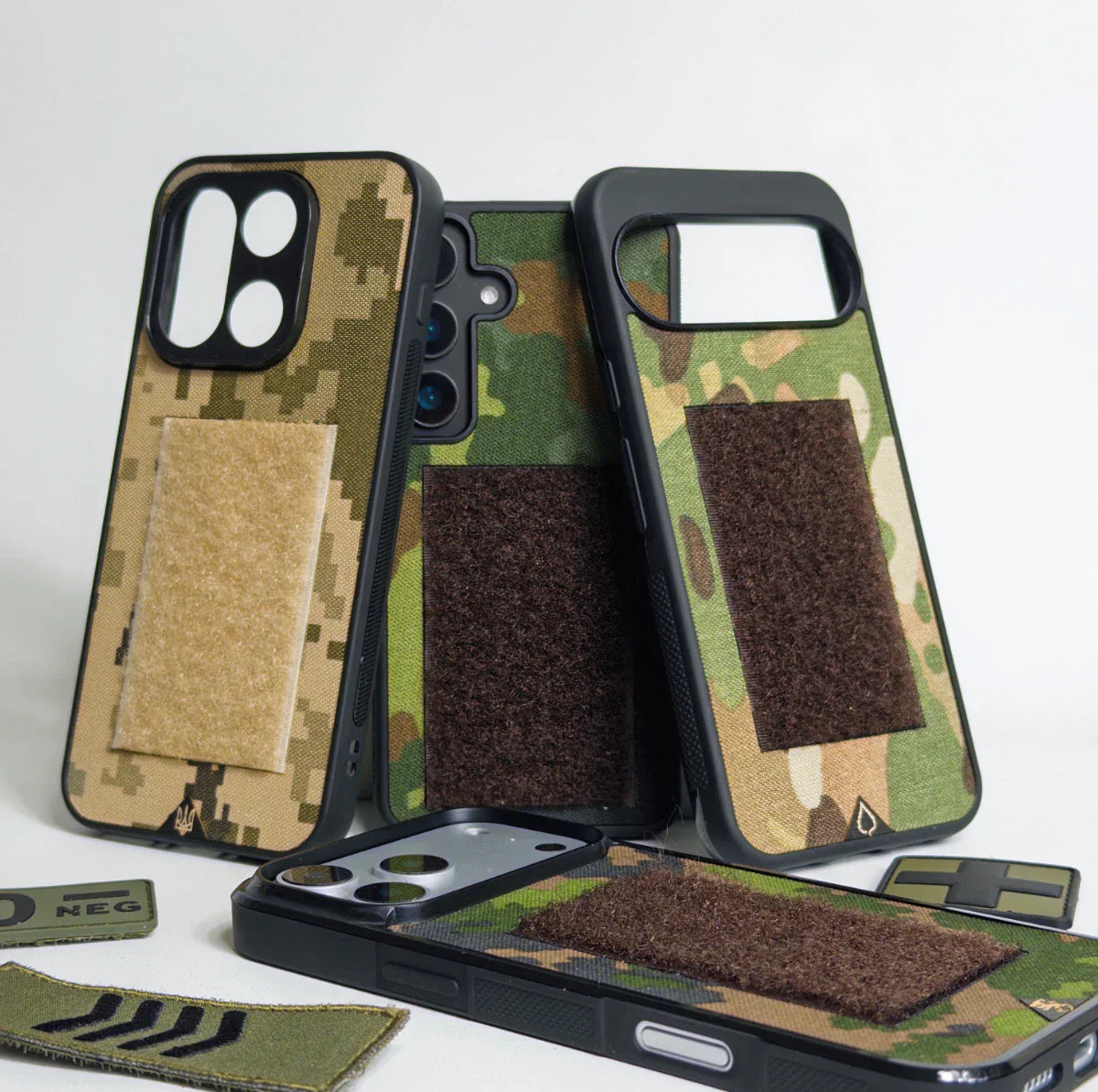
Velcro — from burr to military standard and onto a phone case
Velcro is one of those inventions that’s so everywhere you barely notice it anymore. A jacket collar, a backpack, a safety harness, military gear. And now — a phone case.
Where does it really come from? Who invented it, how does it work, and why is it still the best fastening solution for demanding use? Here’s the whole story.
The burr and the engineer — how Velcro was invented
The year is 1941. Swiss engineer Georges de Mestral returns from a forest hike in the Alps. His wool jacket and his dog’s fur are covered in burrs. An ordinary person removes the burrs and forgets about it. De Mestral puts them under a microscope.
He sees something simple and ingenious: small curved hooks gripping tightly to the loop structure of fabric. Hook and loop. Two surfaces that find each other — and stay together until a peeling force is applied.
De Mestral takes his idea to the textile industry in Lyon, France, where the hook structure starts being replicated in nylon. The process takes years: the patent is filed in 1951 and granted in 1955.
How does Velcro work?
Velcro consists of two surfaces: one has thousands of small, stiff hooks, the other has soft loop fibers. When the surfaces are pressed together, the hooks catch onto the loops and friction holds them in place.
Removal happens with a peeling motion: you pull from one edge, so the hooks release one by one without much force. Pulling it straight off barely works — that’s Velcro’s geometric strength.
High-quality Velcro withstands thousands of opening and closing cycles without losing its grip. In military use, special Velcro is used that also works in wet conditions, mud, and freezing temperatures — conditions where other fasteners fail.

Patches, vests, and field gear
Armies around the world started switching to Velcro back in the 1960s. NASA used it in the Apollo program — and what works in weightless space works pretty well in the forest, too.
Military use falls into two categories: structural attachment (pockets, straps, vest structures) and identification elements (branch insignia, unit patch, name tape, flag, morale patch).
The Nordic Defence Forces’ M05 combat gear makes extensive use of Velcro: the shoulder sections, chest, and sleeves of jackets have standardized patch areas. Internationally, the approach is the same — Germany’s Bundeswehr with its Flecktarn pattern, Ukraine with MM14 gear, Sweden with M90. Nordic Savotta uses Velcro in its tactical backpacks because it’s a practical standard, not a fashion statement.
Why has Velcro lasted for over 70 years? A button snaps, a zipper breaks, a buckle can pop open. Velcro simply works — it doesn’t require precise alignment, handles repeated use, and doesn’t jam. Even when your hand is in a glove and the lights are off.
 Use
Use
Velcro on a phone case — why?
The Velcro hook-and-loop surface on the phone case isn’t a gimmick. It solves two practical needs:
- Attaches to your gear: service members, reservists, and active outdoor folks want their phone attached to a backpack, vest, or jacket — without a separate holder. The Velcro phone case sticks directly to the Velcro surface on your gear. Your phone won’t swing around, needs no adapters, and comes off in seconds when needed.
- Patches on your own phone case: the camouflage phone case has a Velcro surface where you can attach your branch insignia, unit patch, flag, or morale patch. Swap it when the mood changes.
Real fabric, real hook-and-loop surface — no printed stuff
Most “camo phone cases” on the market are just printed patterns on a plastic surface. They look real in photos, but the feel gives the truth away the moment it’s in your hand.
Lastu’s VELCRO phone case is cut from genuine military fabric. Every piece is real fabric, so every phone case has a slightly different pattern placement. That’s not a flaw — that’s the whole point. The back has a standard 50 mm velcro area that fits all common patch sizes.
The phone case fits snugly, the raised edge protects the screen, and the raised camera frame keeps the lenses off the table. Also available as a MagSafe-compatible version — the magnet attaches the KRIP 2.0 finger grip or KARB wallet directly to the phone case.
Fits all the most popular models: iPhone — including the new iPhone 18 Pro and 18 Pro Max — plus Samsung Galaxy (including the S26 series), OnePlus, Google Pixel, and Nothing Phone. Choose your model on the product page — the preview updates in real time.

No print stuff. No shelf stock. From Oulu.
Lastu’s VELCRO phone cases are made to order in Oulu. Choose the fabric, velcro surface, and MagSafe option — your phone case is ready in 2–10 days. Free shipping available.
Engraved Wooden Phone Case – Finland Lion, Moose, Apple Logo
Samsung Galaxy S26, S26 Plus, S26 Ultra, A37 and A57 — the best cases from Lastu